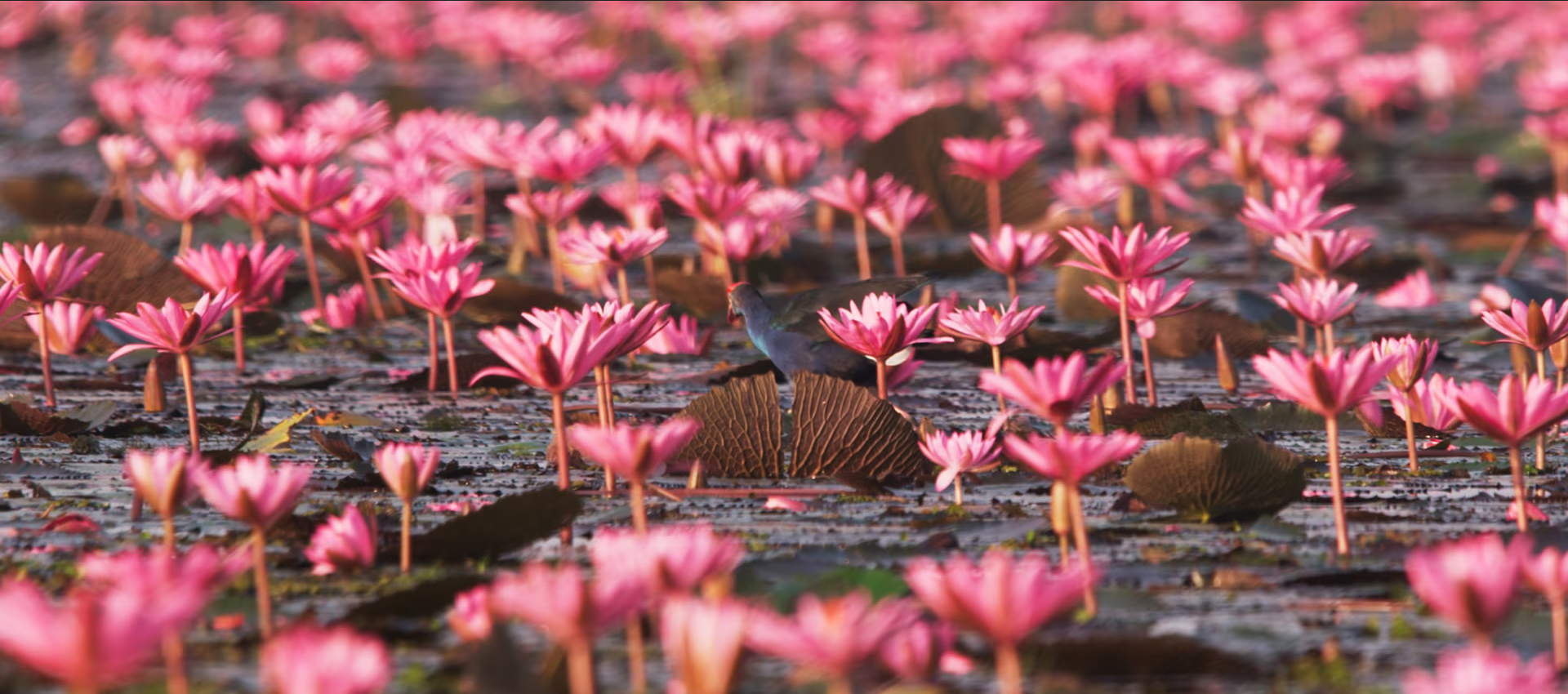
From the aquatic plants surviving the strong currents of Colombia's Rainbow River to giant water lilies fighting for light in Brazil's flooded Pantanal, these plants can thrive in adversity.
The Giant waterlilly
The Giant Water Lily, Victoria amazonica, grows in the Pantanal region of Brazil. It starts as a little bud that grows up towards the surface of the water, before emerging into a beautiful lily pad that can span up to three metres wide. The plant's underside boasts girders and ribs to help support its huge structure. Its underwater stalks, which help to anchor the leaves, can reach up to eight metres in length.1
Macarenia clavigera
When the water level rises, and it has enough sunlight, the Macarenia clavigera plant bursts into a beautiful range of colours, turning the Caño Cristales river in Colombia into a liquid rainbow.2
Water Hyacinth
This floating flower is found native to the Amazon Basin in South America. The Hyacinth can produce up to 20 flowers from one singular stalk, and rise up to 1m above the waterline.3
Water Crowfoot
The Water Crowfoot, or Ranunculus aquatilis, is native through most of Europe, and a member of the buttercup family. This underwater plant grows in mats on the water's surface and has floppy stems, which flex with the water's current. But it sends special, stiff flower-bearing stems up into the air to attract pollinators.4
Water Lettuce
The pantropical water lettuce, Pistia stratiote, carries its name from its lettuce-head-like appearance, and can be found across all continents except Antarctica. In part thanks to its thick and spongy leaves, this aquatic plant is virtually unsinkable. Its roots are not attached to the riverbed, allowing it to travel with the river current.
Sea grass
Sea grass grows in shallow and sheltered coastal areas and has meadows in 159 countries covering 300,000 square kilometres (115,000 square miles).5 This plant is incredibly important as it absorbs 10% of the ocean's carbon each year.6 The grass builds its leaves and roots using the carbon through the process of photosynthesis.